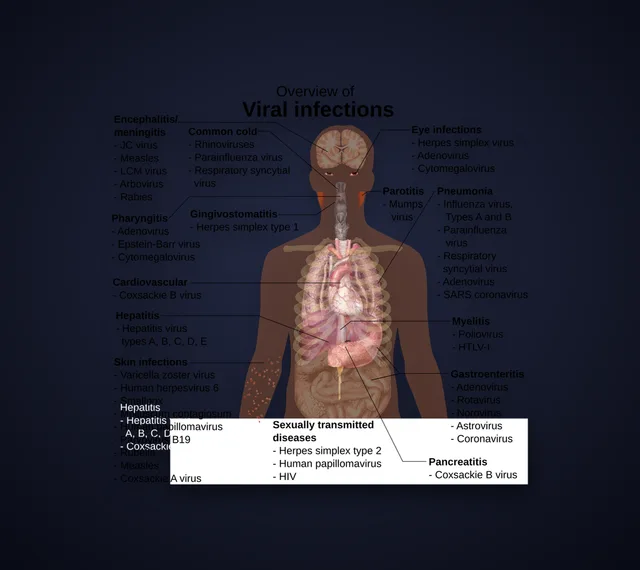
Viral disease

Viral disease
ConceptInfectious Diseases

Disease caused by pathogenic viruses infecting cells

1.60Rare
No. 46530Kosmora

Rare

Viral disease

  • Infectious Diseases

A viral disease, also called a viral infection, occurs when pathogenic viruses invade an organism's body. Infectious virus particles, called virions, attach to and enter susceptible cells. Virosis is a disease or infection caused by a virus. Examples of viral diseases include the common cold, gastroenteritis, COVID-19, influenza and rabies.

Also called
Viral infection
Cause
Pathogenic viruses
Examples
Common cold, gastroenteritis, COVID-19, flu and rabies
Sources and credits

Sources and credits

Article
Viral disease (English Wikipedia)
Wikidata
Q1928978
Text
Card text is adapted from the English Wikipedia article by an automated summary. Wikipedia content is available under CC BY-SA 4.0; see the article history for its contributors. CC BY-SA 4.0 · Article history and contributors
Illustration
By Mikael Häggström. Public domain · File page on Wikimedia Commons
Mikael Häggström, All used images are in public domain. References Mainly Chapter 33 (Disease summaries), pages 367-392 in Fisher, Bruce; Harvey, Richard P.; Champe, Pamela C. Lippincott's Illustrated Reviews: Microbiology (Lippincott's Illustrated Reviews Series), Hagerstwon, MD: Lippincott Williams & Wilkins, pp. 367−392 ISBN: 0-7817-8215-5. For common cold: National Institute of Allergy and Infectious Diseases (NIAID) > Common Cold. Last Updated December 10, 2007. Retrieved on 4 April, 2009 For exclusion of CMV among the main viral STDs: Lucile Packard Children’s Hospital > Sexually Transmitted Diseases (STDs) Retrieved on 5 April, 2009</ref>
Modifications: Placed on a plain background, resized and converted to WebP
Popularity
112 median daily views (Wikimedia Pageviews API (all-access, user agent))

Kosmora is not affiliated with or endorsed by the Wikimedia Foundation.