Cathode

Cathode
ConceptPhysics Concepts and Laws

An electrode from which conventional current leaves

1.60Rare
No. 217149Kosmora

Rare

Cathode

  • Physics Concepts and Laws

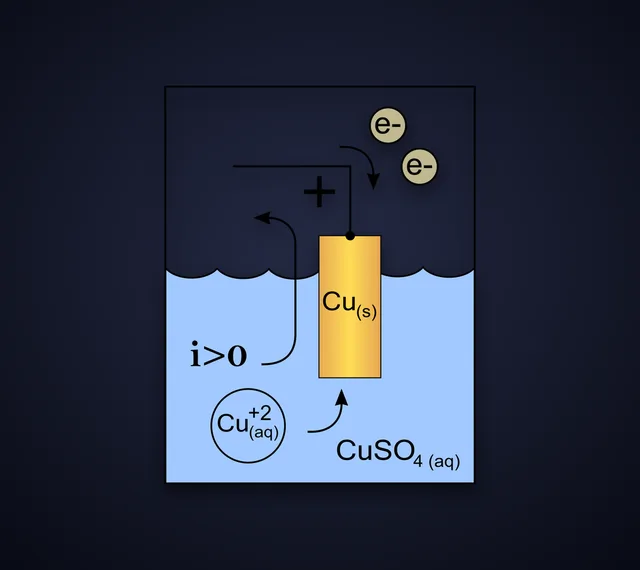
A cathode is an electrode from which conventional current leaves a polarized electrical device, such as a lead-acid battery. Conventional current is the direction in which positive charges move. Because electrons have negative charge, their movement is opposite to conventional current, so electrons flow from the external circuit into a device's cathode. In a household battery, the terminal marked with a plus sign is the cathode. The opposite electrode is the anode.

Electrode role
Conventional current leaves the device through it
Electron flow
Electrons flow into the cathode from the external circuit
Household battery
The plus-marked end is the cathode
Sources and credits

Sources and credits

Article
Cathode (English Wikipedia)
Wikidata
Q175233
Text
Card text is adapted from the English Wikipedia article by an automated summary. Wikipedia content is available under CC BY-SA 4.0; see the article history for its contributors. CC BY-SA 4.0 · Article history and contributors
Illustration
By Original work:File:Zinc anode 2.png by User:MichelJullian (talk) Derivative work: KES47 (talk). CC BY-SA 3.0 · File page on Wikimedia Commons
Original work:File:Zinc anode 2.png by User:MichelJullian (talk) Derivative work: KES47 (talk), File:Copper cathode 2.png
Modifications: Placed on a plain background, resized and converted to WebP
Popularity
137 median daily views (Wikimedia Pageviews API (all-access, user agent))

Kosmora is not affiliated with or endorsed by the Wikimedia Foundation.