Fibonacci sequence

Fibonacci sequence
ConceptInteger Sequences

A number sequence in which each element is the sum of the preceding two.

2.50Epic
No. 02829Kosmora

Epic

Fibonacci sequence

  • Integer Sequences

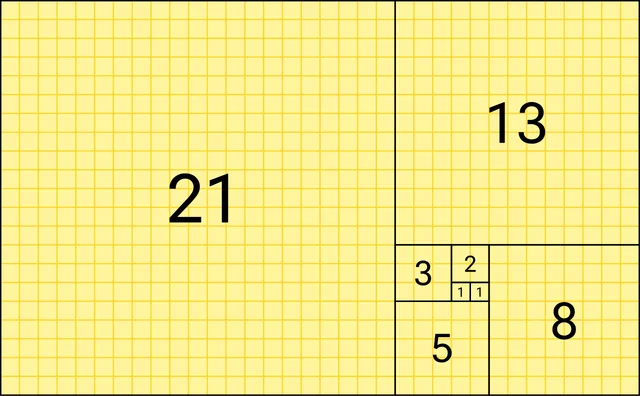
The Fibonacci sequence is a mathematical sequence whose elements are formed by adding the two preceding elements. Its numbers are commonly denoted Fn, and it may begin with F0 = 0, followed by 1, 1, 2, 3, 5 and 8. First described in Indian mathematics, it was introduced to Western European mathematics by Leonardo of Pisa in Liber Abaci. Fibonacci numbers are closely related to the golden ratio and Lucas numbers.

Definition
Each element is the sum of the two preceding elements.
Initial elements
F1 = 1 and F2 = 1, with F0 = 0 also included by many authors.
Western European introduction
Leonardo of Pisa introduced it in his 1202 book Liber Abaci.
Sources and credits

Sources and credits

Article
Fibonacci sequence (English Wikipedia)
Wikidata
Q23835349
Text
Card text is adapted from the English Wikipedia article by an automated summary. Wikipedia content is available under CC BY-SA 4.0; see the article history for its contributors. CC BY-SA 4.0 · Article history and contributors
Illustration
By Romain. CC BY-SA 4.0 · File page on Wikimedia Commons
Romain, Own work
Modifications: Resized and converted to WebP
Popularity
2,396 median daily views (Wikimedia Pageviews API (all-access, user agent))

Kosmora is not affiliated with or endorsed by the Wikimedia Foundation.