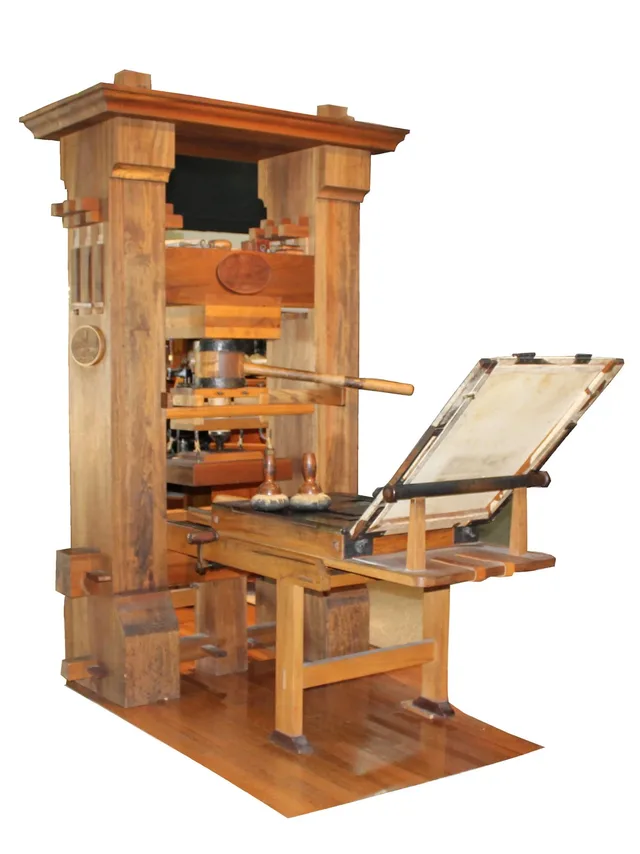
Printing press

Printing press
ObjectHistoric Inventions

Machine press that transfers ink onto paper, cloth, or similar surfaces.

2.50Epic
No. 03530Kosmora

Epic

Printing press

  • Historic Inventions

A printing press is a machine that applies pressure to transfer ink onto paper, cloth, or similar material. Johannes Gutenberg invented it around 1440. Its spread changed literary production and communication in early modern Europe, lowering the cost and increasing the availability of printed texts. Wooden handpress designs remained broadly consistent for more than three centuries, before iron, steam-powered, rotary, offset, phototypesetting, and digital methods developed.

Inventor
Johannes Gutenberg, around 1440
Function
Applies pressure to transfer ink onto a surface
Later replacement
Offset printing, phototypesetting, and digital printing in commercial work
Sources and credits

Sources and credits

Article
Printing press (English Wikipedia)
Wikidata
Q144334
Text
Card text is adapted from the English Wikipedia article by an automated summary. Wikipedia content is available under CC BY-SA 4.0; see the article history for its contributors. CC BY-SA 4.0 · Article history and contributors
Illustration
By International Printing Museum. CC0 · File page on Wikimedia Commons
International Printing Museum, Own work
Modifications: Resized and converted to WebP
Popularity
949 median daily views (Wikimedia Pageviews API (all-access, user agent))

Kosmora is not affiliated with or endorsed by the Wikimedia Foundation.