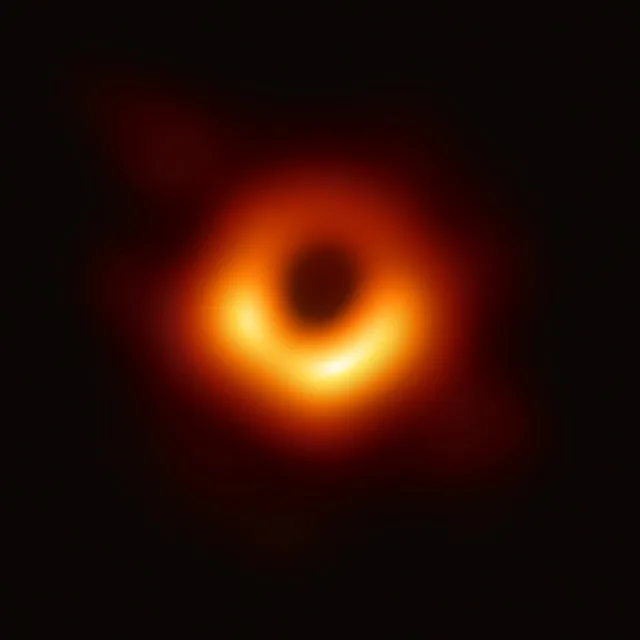
Black hole

Black hole
ObjectBlack Holes and Neutron Stars

Compact astronomical body with gravity that traps light

5.00Legendary
No. 48082Kosmora

Legendary

Black hole

  • Black Holes and Neutron Stars

A black hole is an astronomical body compact enough that its gravity prevents anything, including light, from escaping. Its boundary of no escape is the event horizon. General relativity predicts black holes and a central singularity. They can form when massive stars collapse in supernova events, and can grow by absorbing matter or merging. Black holes may be detected through their effects on matter, light, orbiting stars, or gravitational waves.

Escape boundary
Event horizon
Typical formation
Collapse of massive stars in supernova events
Detection
Effects on matter and electromagnetic radiation
Sources and credits

Sources and credits

Article
Black hole (English Wikipedia)
Wikidata
Q589
Text
Card text is adapted from the English Wikipedia article by an automated summary. Wikipedia content is available under CC BY-SA 4.0; see the article history for its contributors. CC BY-SA 4.0 · Article history and contributors
Illustration
By Event Horizon Telescope, uploader cropped and converted TIF to JPG. CC BY 4.0 · File page on Wikimedia Commons
Event Horizon Telescope, uploader cropped and converted TIF to JPG, This media was produced by the European Southern Observatory (ESO), under the identifier eso1907a This tag does not indicate the copyright status of the attached work. A normal copyright tag is still required. See Commons:Licensing.
Modifications: Resized and converted to WebP
Popularity
5,145 median daily views (Wikimedia Pageviews API (all-access, user agent))

Kosmora is not affiliated with or endorsed by the Wikimedia Foundation.